Kisii National Polytechnic Tenders 2026
Kisii National Polytechnic Tenders 2026–2028: Complete Guide for Suppliers in Kenya
If you are a business owner, supplier, contractor, or service provider looking for reliable government opportunities, the latest tenders from Kisii National Polytechnic present a major opportunity you should not miss.
The institution has officially advertised framework tenders covering the period 2026–2028, giving successful bidders a chance to supply goods and services for three full financial years. This long-term procurement cycle offers stability, predictable income, and business growth for qualified suppliers.
In this detailed guide, you’ll discover:
- All tender categories available
- Key requirements and eligibility criteria
- Step-by-step application process
- Important deadlines and compliance tips
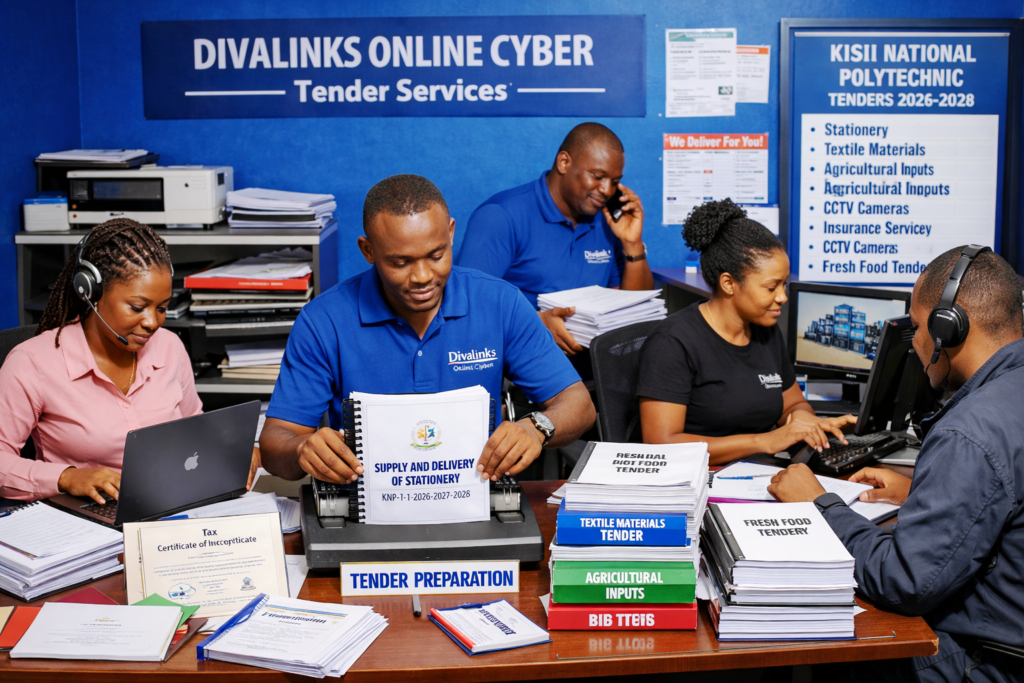
- How Divalinks Online Cyber can help you apply stress-free
[forminator_form id=”185″]
Overview of Kisii National Polytechnic Tenders 2026–2028
The tenders are structured as framework agreements, meaning successful suppliers will be prequalified or awarded contracts to supply goods/services over the three-year period.
This is ideal for:
- SMEs and startups
- Established suppliers
- Youth, women, and PWD-owned businesses (AGPO)
- Service providers across multiple industries
The procurement covers a wide range of sectors including:
- Supplies
- Maintenance services
- ICT solutions
- Consultancy
- Logistics
- Agriculture and food supply
Full List of Tender Categories (2026–2028)
Below is a complete breakdown of all tender categories as advertised:
Core Supply Tenders
- KNP-T-1: Supply and Delivery of Stationery
- KNP-T-2: Supply and Delivery of Textile Materials
- KNP-T-3: Supply and Delivery of Agricultural Inputs and Animal Feeds
- KNP-T-10: Supply of Firewood and Charcoal
- KNP-T-17: Supply and Delivery of Foodstuff
- KNP-T-18: Supply and Delivery of Detergents and Cleaning Materials
Food & Perishable Supplies
- KNP-T-08: Fresh Vegetables and Fruits
- KNP-T-09: Fresh Meat, Poultry and Fish
Technical & Mechanical Supplies
- KNP-T-16: Mechanical Production and Automotive Materials
- KNP-T-34: Supply and Delivery of Machines and Equipment
- KNP-T-06: Tyres and Tubes
- KNP-T-25: Fuel and Lubricants
- KNP-T-26: Cooking Gas, Oxygen and Oxy-Acetylene
ICT & Technology
- KNP-T-24: Computers, Printers, Accessories & ICT Software
- KNP-T-27: Network Equipment and Structural Cabling
- KNP-T-31: CCTV Cameras Installation
- KNP-T-32: Biometric Systems Installation
Electrical & Engineering
- KNP-T-11: Electrical and Electronics Items
- KNP-T-14: Hardware and Building Materials
Health & Medical Supplies
- KNP-T-07: Human Drugs, Dressings, Sutures
- KNP-T-22: Fire Fighting Equipment Servicing
Institutional Supplies
- KNP-T-12: Staff Uniforms and House Fittings
- KNP-T-23: Sports Uniforms and Equipment
- KNP-T-15: Hairdressing and Beauty Therapy Materials
Services-Based Tenders
- KNP-T-5: Repair and Maintenance of Plant and Machinery
- KNP-T-13: Organization of Events
- KNP-T-19: Security Services
- KNP-T-21: Insurance Services
- KNP-T-28: Artwork, Signage, Posters and Banners
- KNP-T-30: Printing and Publishing
- KNP-T-33: Publicity and Advertisement
Prequalification Categories (KNP-PRE)
ICT & Digital Services
- Electronic Voting Systems
- Cloud Computing Services
- IP Telephony Installation
- ICT Systems Supply & Installation
Transport & Logistics
- Motor Vehicle Repair Services
- SGR Services
- Air Ticketing Services
Supplies & Equipment
- Library Books
- Furniture and Fittings
- Cutlery and Utensils
- Drama and Musical Instruments
- General Machines and Equipment
- Livestock Supply
Professional & Consultancy Services
- Consultancy Services
- Asset Valuation and Tagging
Facility & Support Services
- Accommodation and Conference Facilities
- Landscaping Services
- Counselling, HIV Testing and Cancer Screening
- Exhaust Services
- Kitchen Equipment Maintenance
- Chairs, Tents, PA System & Videography
- Fumigation and Pest Control
Infrastructure & Small Works
- Procurement of Small Works
Why These Tenders Are Important
Participating in Kisii National Polytechnic tenders gives you:
1. Long-Term Business Stability
Contracts run from 2026 to 2028, ensuring consistent income.
2. Government Credibility
Working with a national institution boosts your business profile.
3. Diverse Opportunities
From ICT to agriculture, almost every industry is covered.
4. Access to AGPO Benefits
Youth, women, and PWD groups get preferential consideration.
Requirements for Tender Application
To successfully apply, you must prepare the following documents:
Mandatory Documents
- Copy of Business Registration Certificate
- Valid KRA PIN Certificate
- Tax Compliance Certificate
- Company Profile
- CR12 (for companies)
Financial & Technical Documents
- Bank statements (6 months)
- Audited accounts (if required)
- Proof of past experience
- Reference letters
Special Requirements
- AGPO Certificate (if applicable)
- NCA Certificate (for construction-related tenders)
- Relevant licenses (e.g., medical, ICT, security)
Step-by-Step Tender Application Process
Step 1: Identify Relevant Tender
Choose the category that matches your business.
Step 2: Download Tender Documents
Obtain official tender documents and read carefully.
Step 3: Prepare Documents
Compile all required certificates and forms.
Step 4: Fill Tender Forms
Ensure:
- No missing fields
- Correct pricing format
- Proper signing and stamping
Step 5: Compile Tender Book
Arrange documents in the correct order:
- Technical proposal
- Financial proposal
- Attachments
Step 6: Submit Before Deadline
Submit physically or as instructed in the tender notice.
Important Deadlines
- Submission deadlines are strictly enforced
- Late applications are automatically rejected
- Always aim to submit at least 1–2 days earlier
Common Mistakes to Avoid
- Missing documents
- Expired tax compliance certificate
- Wrong tender number
- Poor document arrangement
- عدم signing required pages
Even a small mistake can lead to automatic disqualification
How Divalinks Online Cyber Can Help You
Applying for tenders can be overwhelming—but this is where Divalinks Online Cyber comes in.
We provide end-to-end tendering support, including:
✔ Tender Identification
We help you choose the right category for your business.
✔ Document Preparation
We ensure:
- All documents are valid
- Proper formatting is done
- Compliance is met
✔ Tender Book Compilation
We professionally arrange your tender documents to meet evaluation standards.
✔ Submission Services
We:
- Print and bind your tender documents
- Deliver them directly to Kisii National Polytechnic
- Ensure submission before deadline
✔ Remote Convenience
You don’t need to visit our office.
👉 Just:
- Call us
- Send documents via WhatsApp or email
- We handle everything
Why Choose Divalinks Online Cyber?
- Fast and reliable service
- Professional tender preparation
- Affordable pricing
- Experience with government tenders
- 100% remote service delivery
We make the entire process simple, fast, and stress-free
Tips to Increase Your Chances of Winning
- Apply for multiple relevant categories
- Ensure full compliance with requirements
- Provide strong references
- Price competitively but realistically
- Work with professionals (like Divalinks)
Final Thoughts
The Kisii National Polytechnic Tenders 2026–2028 present a golden opportunity for suppliers across Kenya. Whether you deal in goods, services, ICT, or consultancy, there is a category tailored for your business.
With contracts running for three years, this is not just a tender—it’s a long-term business investment.
Call To Action (CTA)
📞 Apply Today with Ease!
Let Divalinks Online Cyber handle everything for you:
- Tender application
- Documentation
- Submission
👉 No queues. No stress. No physical visits.
Just one call—and your tender is professionally handled from start to finish.
This is actually a solid opportunity, especially for small businesses trying to break into institutional supply chains. I like that Kisii National Polytechnic is opening up multiple categories—from basic supplies like stationery to more technical services like ICT systems and CCTV installation—because it gives both beginners and more established vendors a shot. What really stood out to me is the two-year framework contract, which could provide some level of consistency if awarded, but at the same time, I think people need to go into tenders like this with their eyes open—documentation, compliance, and deadlines can make or break you. I’d love to hear from anyone who has actually applied to similar tenders before—what was your experience like, especially when it comes to payment timelines and competition?
Thank you so much for your thoughtful comment! You’re absolutely right—tenders like the ones at Kisii National Polytechnic are a fantastic opportunity for small businesses to enter institutional supply chains, whether it’s for stationery, ICT systems, or CCTV installations. The two-year framework contract can indeed provide consistency, which is a huge benefit for vendors who secure it.
Success in these tenders usually comes down to preparation: having all your documentation ready, understanding compliance requirements, and meeting deadlines. Payment timelines can vary depending on the institution, so it’s always wise to clarify terms upfront. Competition is usually strong, but smaller vendors shouldn’t be discouraged—they can often provide specialized services or competitive pricing that larger companies can’t match.
For anyone looking to navigate these opportunities effectively, I highly recommend checking out our Kenya Tender Guides at Divalinks, where we cover tips on applying, bidding, and managing institutional contracts. With the right approach, these tenders can be a real stepping stone for growing your business sustainably!
This is a really strong and practical piece, especially for anyone in Kenya trying to break into government contracting.
From a broader perspective, tenders like this are one of the most underestimated business opportunities out there. Everyone online is chasing things like affiliate marketing, dropshipping, or crypto… but structured government contracts can offer something those don’t, predictability and stability.
The 2026–2028 framework aspect is huge. A 3-year window isn’t just a short-term win, it gives businesses a chance to plan, grow, and reinvest with some level of confidence. That’s something most small businesses struggle to find.
I also like how detailed the categories are. It shows that opportunities aren’t just for big companies, there’s room for small suppliers, service providers, and even niche businesses. The inclusion of AGPO groups is especially important because it lowers the barrier for youth and smaller players.
That said, if I’m being honest, the biggest challenge with tenders isn’t finding them, it’s execution and compliance. A lot of people miss out not because they’re unqualified, but because of small mistakes (missing documents, formatting issues, deadlines). So the emphasis on preparation and avoiding errors is spot on.
The only thing I’d encourage readers to be cautious about is relying entirely on third-party services. They can be helpful, especially for beginners, but it’s still important to understand the process yourself so you’re not dependent long-term.
Overall, this is a solid guide that highlights a real opportunity, not hype, not shortcuts, but a legitimate path to business growth if done correctly.
Curious; do you see more first-time applicants winning these tenders, or is it mostly businesses that already have experience with government contracts?
For the new beginners hopefully you are talking of new companies, since is a frame work for 3 years, if they get themselves well prepared they can win the tenders and that is why the government encourages the disadvantaged groups to apply i.e youth, women and PWD. others thanks for the positivity are showing you may contact us via whatsApp no. +254728206890